BLOG
AISecOps: The Future of AI-Driven Security Operations
Why Intelligent Security Operations Need More Than Traditional SIEM

For years, security operations has been defined by a familiar rhythm: monitor infrastructure, detect threats, respond to incidents. CISOs built programmes around that cadence, and it worked, right up until the moment AI fundamentally rewrote the rules.
AI systems are now consuming, generating, and influencing enterprise decisions at scale. Organisations are no longer protecting networks and endpoints alone, they are protecting data pipelines, AI interactions, decision logic, and the integrity of machine-driven outcomes. The attack surface has expanded to include the AI systems themselves: the models, the prompts, the training data, and the operational telemetry that feeds them.
This shift demands a new operational model, one built not just for the threats of today, but for the AI-native enterprise that is already taking shape and growing.
of cyber incident response will involve AI applications by 2028
In IT, AIOps (Artificial Intelligence for IT Operations) has become mainstream — automating infrastructure monitoring, incident correlation, and operational efficiency at scale. But security teams face a fundamentally different and more adversarial challenge.
Modern cyber environments generate tens of billions of telemetry events daily. Threat actors move faster, environments are more distributed and ephemeral, and security analysts are overwhelmed by alert noise, fragmented visibility, and escalating investigation complexity.
For MSSPs managing dozens of client environments and CISOs accountable for enterprise-wide risk posture, the core problem isn’t a lack of data, it’s the inability to convert data into timely, trustworthy intelligence.
This is where AISecOps (Artificial Intelligence Security Operations) emerges as the next operational evolution in cybersecurity. And critically: AI alone is not the transformation. Intelligent security outcomes depend on trusted, governed, high-quality security data.
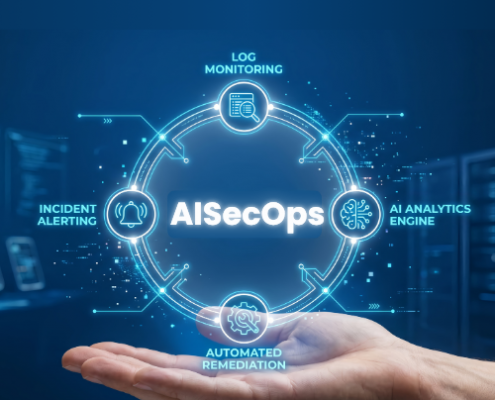
AISecOps (Artificial Intelligence Security Operations) is the operational discipline of integrating AI-driven intelligence, automation, and data governance into security operations to improve threat detection efficacy, investigation velocity, and analyst effectiveness.
It is not a product category. It is an operational model — one that elevates every component of the security operations lifecycle:
| AISecOps Capability | Operational Outcome |
| AI-assisted threat detection | Reduced mean time to detect (MTTD) |
| Behavioural anomaly analysis | Surface low-and-slow attacks missed by rules |
| Automated triage and prioritisation | Reduced analyst alert fatigue |
| Natural language investigation assist | Faster root-cause analysis |
| Long-term telemetry retention | Post-incident forensic reconstruction |
| Federated data governance | Compliance-ready evidence chains |
| Intelligent log routing | Optimised SIEM ingestion costs |
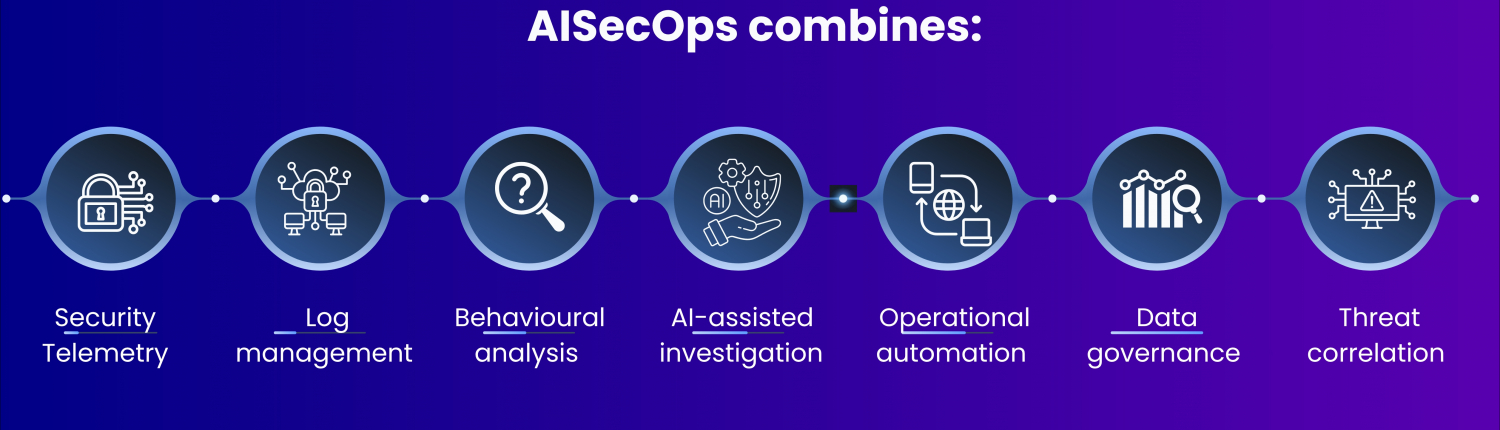
AISecOps combines security telemetry, log management, behavioural analysis, AI-assisted investigation, operational automation, data governance, and threat correlation to create a more intelligent and adaptive security operation.
Unlike traditional security automation, which focused on reducing manual tasks through scripted runbooks, AISecOps is about improving decision quality. The distinction matters enormously for MSSPs operating under SLA pressure and CISOs making risk decisions in real time.
Security Operations Centres were architected for a different era. They assumed a relatively bounded perimeter, predictable data volumes, and centralised log collection into a SIEM. None of those assumptions hold today.
Modern enterprise environments now span:
Every one of these generates logs and telemetry. The result: security teams are drowning in data but starving for context.

Most organisations, and the MSSPs servicing them, still operate with foundational gaps that directly limit AI effectiveness:
The gap between collecting logs and generating actionable intelligence is where most breach dwell time lives. Attackers exploit this window consistently, average dwell time before detection remains measured in weeks, not hours.
Traditional SOC architectures were built around centralised SIEM platforms as the single source of truth. That model was appropriate when environments were bounded and data volumes were manageable. Neither is true today.
AISecOps introduces a broader operational model that distributes intelligence across the telemetry pipeline rather than concentrating it at ingestion:
| Traditional Security Operations | AISecOps |
| Reactive alert monitoring | Proactive, intelligence-led threat analysis |
| High SIEM ingestion costs driving log reduction | Optimised telemetry pipelines with tiered storage |
| Siloed data visibility per tool | Federated security intelligence across environments |
| Manual investigation workflows | AI-assisted investigation with contextual enrichment |
| 30–90 day retention windows | Long-term forensic readiness (12+ months) |
| Static SIEM correlation rules | Adaptive AI-driven behavioural analysis |
| Infrastructure-centric operations | Intelligence-centric, outcome-driven operations |
| Alert volume as a performance metric | MTTD, MTTR, and investigation quality metrics |
| Single SIEM vendor dependency | Vendor-agnostic, composable security data pipelines |
This transition is not theoretical. It is being driven by the practical limitations of legacy architectures under modern threat conditions. CISOs are increasingly required to demonstrate investigation-ready posture to boards, regulators, and insurers, not just alert counts and response times.
One of the most under-invested areas in security operations is investigation readiness, the ability to answer the question: “If we were breached six months ago, could we reconstruct what happened?”
For most organisations, the honest answer is no. Logs have been rotated out. Coverage gaps existed. Telemetry was not normalised. The forensic chain is broken.
For MSSPs and CISOs, investigation readiness is increasingly a compliance requirement, not just a best practice:
MSSPs that cannot demonstrate investigation-ready telemetry pipelines for client environments are increasingly exposed to contractual and regulatory liability when incidents occur.
The organisations, and MSSPs, that succeed with AISecOps will combine skilled analysts, strong governance frameworks, high-quality telemetry pipelines, and intelligent AI augmentation. The constraint is not the AI. It is the data and the operational discipline around it.
Snare’s log replay capability allows archived telemetry to be re-ingested into upstream SIEM or analytics platforms for retrospective analysis. This is operationally significant when new threat intelligence, detection rules, or AI models become available, historical data can be re-analysed against current detection logic without reprocessing costs.
Snare integrates with all major SIEM platforms, cloud-native security services, and security analytics ecosystems without creating lock-in. For MSSPs managing heterogeneous client environments across multiple SIEM vendors, this is architecturally critical.
By ensuring telemetry is consistently collected, normalised, governed, and retained, Snare creates the data foundation that makes downstream AI tools more reliable, more accurate, and more operationally trustworthy. The AI is only as good as what it is trained and operated on.
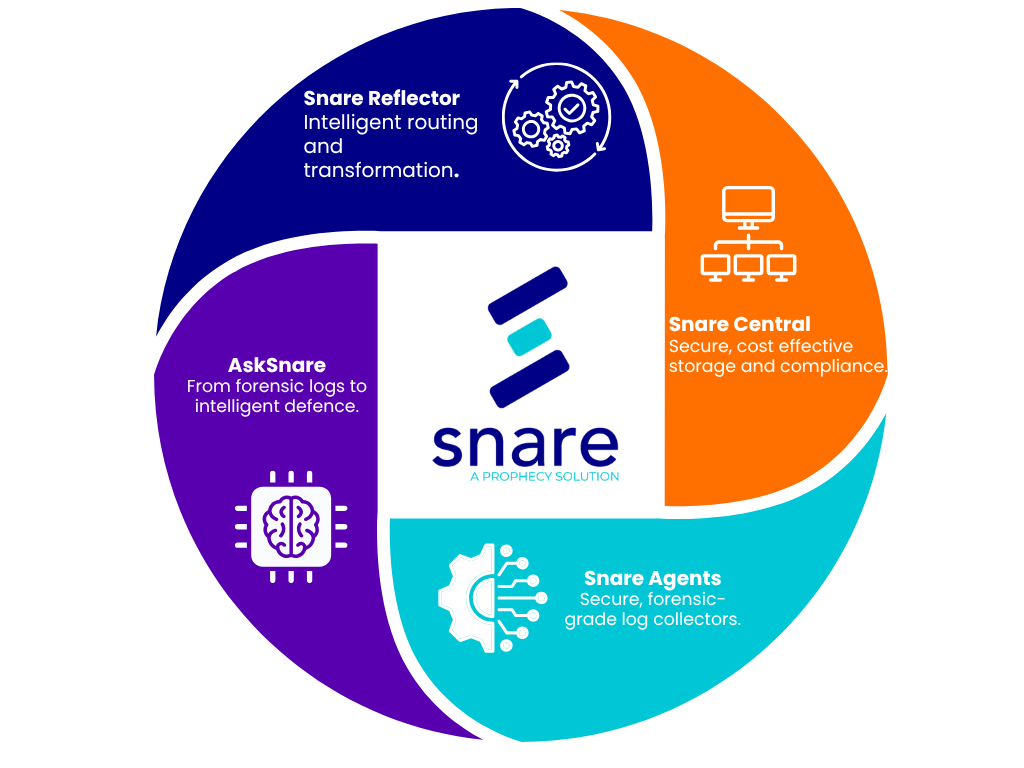
Snare Solutions provides the foundational telemetry, forensic logging, and intelligent data control required to operationalise AISecOps effectively. Snare addresses the most critical and most commonly under-solved challenge in AI-driven security operations: trusted, scalable, investigation-ready security data.
Rather than competing in the detection or SIEM space, Snare strengthens the entire security telemetry lifecycle, from collection through governance through long-term retention and replay.
Snare captures and retains high-value security telemetry across endpoints, infrastructure, cloud environments, and critical systems. Collection is designed for forensic integrity, not just operational monitoring, with support for cryptographic log signing, tamper detection, and evidence-grade chain of custody.
One of the most significant operational challenges for MSSPs is the cost of SIEM ingestion at scale. Snare’s intelligent routing capability allows organisations to control what data goes where, sending high-priority operational telemetry to the SIEM while routing high-volume, lower-priority data to cost-effective long-term storage. This decouples coverage from cost, enabling organisations to collect everything without paying SIEM rates for everything.
Snare enables affordable long-term log retention, 12, 24, or 36+ months, to support investigation readiness, regulatory compliance, and retrospective threat hunting. For MSSPs, this addresses a critical client liability gap and creates a differentiable service capability.
The next generation of security operations will not be defined by who collects the most data, deploys the most tools, or generates the most alerts. It will be defined by operational capability across five dimensions:
| Capability | What It Requires | Where Snare Enables It |
| Operationalise intelligence faster | Low-latency telemetry pipelines | Real-time collection and routing |
| Govern security data effectively | Data lineage, access controls, integrity | Forensic-grade log governance |
| Reduce operational complexity | Vendor-agnostic, composable architecture | SIEM-agnostic integration layer |
| Retain meaningful telemetry | Cost-effective long-term storage | Tiered retention and replay |
| Generate trustworthy AI insights | Clean, normalised, complete data | AI-ready telemetry foundations |

For MSSPs, this represents both a service differentiation opportunity and a delivery risk management imperative. Clients are increasingly asking: “Can you prove you could have detected this 90 days ago?” The answer requires investigation-ready telemetry, not just current alerting capability.
For CISOs, the conversation with boards and regulators is shifting from “How many alerts did we respond to?” to “How quickly could we reconstruct a breach?” and “How confident are we in our AI-driven detection coverage?” Both questions have data quality as a prerequisite.

| AISecOps is not simply the next cybersecurity buzzword. It represents a fundamental shift in how organisations think about security operations in an AI-driven world, and the infrastructure required to make that shift real. |
As environments become more complex and threats more sophisticated, security teams can no longer rely on fragmented visibility, reactive investigations, or uncontrolled data growth. The future of cybersecurity depends on the ability to combine intelligent automation with trusted, governed, investigation-ready security data.
AI can accelerate analysis, surface hidden patterns, and improve operational efficiency, but only when built on a strong security data foundation. Organisations and MSSPs that invest now in better telemetry, smarter log management, and long-term investigation readiness will gain meaningful, measurable advantage in both resilience and response.
The future of security operations will not belong to organisations with the most alerts. It will belong to those with the clearest intelligence.


 Global Cyber & AI Regulation: Logging & Evidence Compliance Matri...