
BLOG
More security data should mean better visibility. For a growing number of organizations, it means the opposite.
As endpoints, cloud platforms, SaaS applications, network devices, identities, and security tools generate more logs than ever, SIEM environments are being asked to ingest, index, and retain volumes they were never architected around. Enterprise telemetry growth is running at roughly 20–30% a year, driven by cloud migration, containerization, SaaS adoption, and identity proliferation, and that growth compounds against whatever pricing model a SIEM uses to charge for it.
Here’s the problem: not every event carries equal security value. High-value evidence, the log line that actually shows how an attacker moved, escalated, or exfiltrated, is routinely buried under repetitive system messages, duplicate events, low-priority noise, and data with little relevance to detection, investigation, or compliance.
The consequence isn’t just a bigger invoice. It’s slower investigations, harder-to-scale operations, and, in the worst case, the exact evidence an incident response team needs six months from now that was filtered out, dropped, or never collected properly in the first place.
Below are seven signs your SIEM may be ingesting more noise than value, along with what a more deliberate approach to security data looks like in practice.

1. SIEM Costs Are Rising Faster Than Security Coverage
Most SIEM pricing is tied in some way to data ingestion, indexing, storage, or workload consumption. As log volumes grow, the bill grows with them, even when the organization hasn’t added a single new detection capability.
The numbers back this up. Published 2026 list pricing shows just how wide the gap between platforms can be: Splunk’s traditional ingestion licensing runs from roughly USD $6.50 to over $225 per GB/day annually, Microsoft Sentinel’s pay-as-you-go rate sits around USD $2.96–$5.59 per GB depending on commitment tier, and Elastic Security ranges from roughly USD $0.55–$1.10 per GB.[^1]
At 20–30% annual telemetry growth, a manageable SIEM bill today can become unsustainable within two or three renewal cycles, without a single analyst added or a single new threat detected.
What to watch for: If your year-over-year SIEM spend is climbing faster than your MTTD/MTTR, detection coverage, or headcount, that’s a signal you’re paying to process volume, not value.
This doesn’t mean collecting less data. It means managing data more intelligently before it reaches the SIEM, filtering, prioritizing, compressing, and routing logs at the source so ingestion reflects security value rather than raw volume.
2. Analysts Spend Too Much Time Searching Through Irrelevant Events
A SIEM can hold billions of events and still fail to produce insight quickly. When analysts have to sift through repetitive login activity, routine service messages, duplicated events, and low-priority system records, investigations slow down, not because the answer isn’t in the data, but because it’s too hard to find in time.
Excessive noise touches nearly every workflow security teams rely on:
- Alert triage
- Threat hunting
- Incident investigation
- Root-cause analysis
- Compliance reporting
- Forensic reconstruction

Example: A mid-sized financial services firm investigating a suspected account takeover found that 40% of the events returned by their initial search query were duplicate authentication logs from three overlapping collection paths, time the analyst spent filtering manually before the real investigation even began.
This is also where noise becomes a security problem in its own right. The SANS 2025 Detection and Response Survey found that 73% of security teams now name false positives as their top detection challenge, and that burden compounds when unfiltered, duplicate-heavy log volume is what’s feeding the detection layer to begin with.[^2] Noise at the point of ingestion becomes noise at the analyst’s desk.
Effective log management improves the signal before investigation begins, so the SIEM receives data that’s relevant, structured, and ready to support action.
3. Duplicate Events Are Consuming Ingestion and Storage Capacity
Duplicate logs are one of the most common, and most hidden, sources of SIEM waste. The same event can be generated by multiple systems, collected through overlapping tools, or forwarded more than once through the security architecture. In many environments, this duplication builds up gradually as new platforms and data paths are layered on over time.
The result: organizations pay to ingest and retain several versions of the same activity, without gaining any additional visibility.
Duplication doesn’t just waste budget. It complicates investigations, analysts have to determine whether five records represent five separate incidents or one event copied five times, and inflated event counts can make routine activity look more significant than it is.
De-duplication before SIEM ingestion reduces unnecessary volume while preserving the integrity of the original security evidence. The goal isn’t to remove useful data, it’s to stop paying repeatedly for the same information.

4. Everything Is Being Sent to the Same Destination
Not every log belongs in the SIEM. Some data is essential for real-time detection. Some exists primarily for compliance. Some needs to be retained for future investigations but doesn’t need to be indexed immediately. Other events are operationally useful but carry limited security value.
When every log is routed to the same platform by default, the SIEM becomes the catch-all destination regardless of purpose, driving up cost and diluting the platform’s effectiveness at the one job it’s built for: analytics and correlation.
A more strategic architecture routes data according to its value and intended use:
- High-priority security events go directly to the SIEM
- Compliance data is retained in a lower-cost archive
- Operational logs are routed to the appropriate analytics platform
- Data needed by multiple tools is distributed without creating duplication
- Low-value events are filtered before they ever consume ingestion capacity
Analyst perspective: Gartner’s Market Guide for Log Monitoring and Analysis Solutions recommends organizations evaluate whether a telemetry pipeline will be impactful as a first step in vendor selection, before choosing an analytics platform, not after.[^3] Filtering bolted on after collection isn’t the same as control designed in at the point of collection.
Intelligent routing lets the SIEM focus on the security data that requires active analysis, while everything else is retained or delivered where it creates the most value.
5. Retaining Logs for Compliance Is Becoming Unaffordable
Many regulatory, contractual, audit, and investigative requirements call for 12 months or more of log retention. Retaining all of that data in a premium SIEM tier, however, can be prohibitively expensive.
This forces an uncomfortable trade-off: retain less and risk not having evidence when it’s needed, or retain everything and accept escalating storage and licensing costs. Neither is a real answer.
Long-term retention should be separated from high-cost, high-performance SIEM ingestion where appropriate. Security teams need the ability to preserve logs in a compressed, tamper-resistant, investigation-ready form without keeping every event continuously indexed in an expensive analytics tier, controlling cost while maintaining access to the historical evidence compliance and forensic reconstruction depend on.

Example: A healthcare provider subject to HIPAA retention requirements moved two years of low-priority operational and access logs out of active SIEM indexing and into compressed, forensic-grade archival storage, cutting retention costs while keeping the data fully retrievable and audit-ready.
6. Important Events Are Still Being Missed

Security teams need confidence in the quality, completeness, and integrity of their log data, not just the quantity. Effective log management starts at the source, ensuring relevant events are captured, normalized, and reliably delivered before they become part of the broader security analytics environment.
A noisy SIEM isn’t necessarily a complete one. Organizations can ingest enormous volumes of data and still miss the events that matter most.
This tends to happen when:
- Critical endpoints aren’t reporting correctly
- Audit policies are inconsistent across systems
- Logs are dropped during collection or transmission
- Data formats are incompatible with downstream tools
- Important fields aren’t mapped correctly
- High-value events are buried beneath low-value activity
More volume can create the appearance of visibility without any assurance that the right events are actually being captured. And the stakes of getting this wrong are measurable: IBM’s Cost of a Data Breach Report 2025 put the average cost of a U.S. data breach at USD $10.22 million, with the breach lifecycle averaging 241 days, roughly 181 days to detect and 60 to contain.[^4] Time-to-identify and time-to-contain are directly dependent on whether the right log was captured, normalized, and available in the first place.
7. Your SIEM Is Being Used as a Log Collection Tool

A SIEM is designed for security analytics, correlation, detection, and investigation. It was never meant to carry the full burden of collecting, processing, retaining, and distributing every log generated across an organization.
When the SIEM becomes the primary collection layer, security teams end up using an expensive analytics platform for functions that could be handled more efficiently earlier in the pipeline, making the entire environment harder to scale as the organization grows.
A dedicated log management layer collects events from endpoints and systems, applies filtering and routing policies, compresses data, transforms formats, and delivers high-value information to the SIEM, freeing the SIEM to do what it does best: analyze security data and help teams detect and respond to threats.
More Data Does Not Always Mean More Security
The purpose of logging isn’t to collect the greatest possible volume of information. It’s to ensure the organization has the right evidence, in the right format, available at the right time.
When every event is treated equally, SIEM costs rise, investigations slow down, and analysts spend more time managing data than acting on it. But the fix isn’t indiscriminate reduction, either, aggressive filtering without the right controls can strip out events that later prove essential to an investigation or audit. Log management has to preserve forensic value while reducing unnecessary ingestion, which means making deliberate decisions about:
- What should be collected
- What should be filtered
- What should be compressed
- What should be retained
- What should be routed to the SIEM
- What should be sent to another platform
- What must remain available for future investigation

Turn Log Volume Into Security Value With Snare
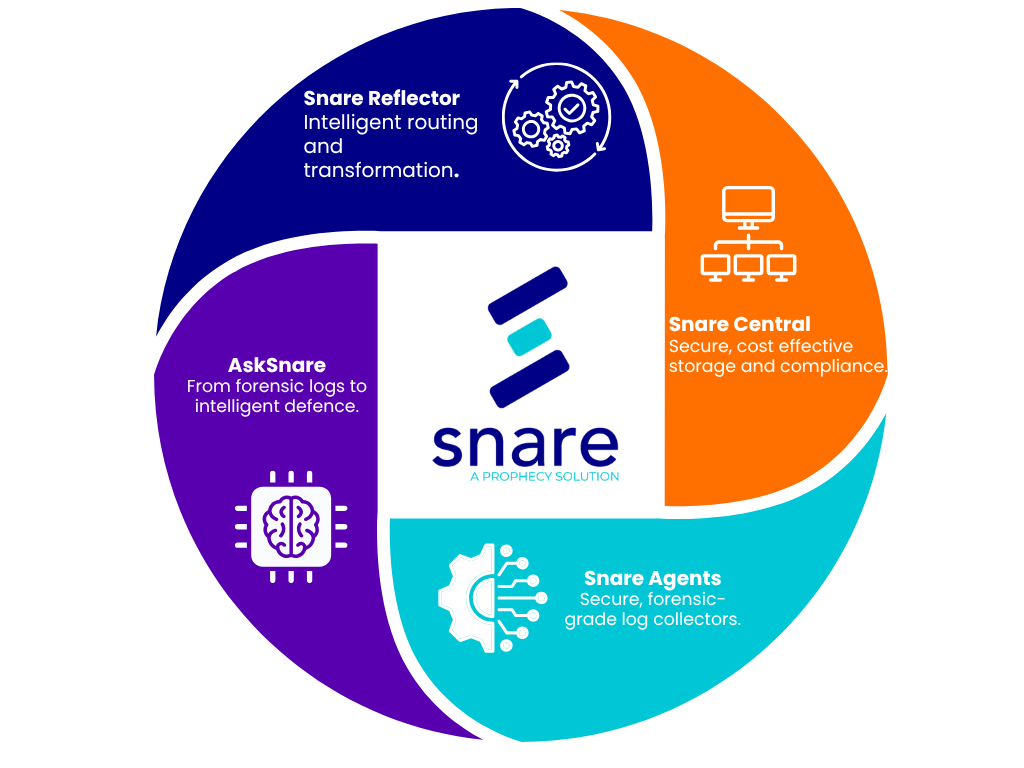
This is precisely the layer Snare is built for. Snare gives organizations control over security data before it reaches the SIEM — collecting forensic-grade logs from endpoints and systems, then enabling security teams to filter, compress, transform, and route that data according to operational, security, and compliance requirements.
Security and IT leaders commonly evaluate this kind of data architecture against four criteria — Cost, Compliance, Coverage, and Control — and Snare is built around the same framework:
- Cost: Replace ingestion-based pricing with a predictable model. Snare customers report 90–98% storage savings at rest by filtering, truncating, transforming, and reducing data volumes without compromising on security.
- Compliance: Meet globally recognized standards — PCI-DSS, HIPAA, ISO 27001, GDPR, SOX, NERC, NIST, and more — with retention and evidence that hold up to audit.
- Coverage: Collect complete, vendor-agnostic security data across on-prem, cloud, and hybrid environments, closing blind spots rather than trading visibility for cost control.
- Control: Break free of vendor lock-in with a single agent that routes data to any SIEM or analytics platform — Splunk, Microsoft Sentinel, IBM QRadar, Elastic, OpenSearch, Devo, Securonix, Chronicle, and more — keeping your data, and your architecture, under your control.
How Snare Technically Reduces SIEM Costs
The savings aren’t the result of a single feature — they come from where Snare sits in the pipeline and what it does before data ever reaches the SIEM:
- Filtering at the agent, not after ingestion. Snare Agents apply objective and subjective filtering criteria — event type, source, severity, field values — at the point of collection, on the endpoint itself. Low-value and irrelevant events are excluded before they ever consume network bandwidth or SIEM licensing capacity, rather than being ingested and filtered out afterward.
- De-duplication and compression. Repeated events generated by overlapping collection paths are consolidated, and log data is compressed for transit and storage — reducing both the volume sent to the SIEM and the footprint of anything retained in long-term archives.
- Format normalization and transformation. Snare standardizes disparate log formats — Windows Event Logs, Syslog, application and cloud logs — into consistent, structured output before delivery, reducing the parsing and normalization overhead SIEMs otherwise have to absorb on ingestion.
- Tiered, policy-based routing. Snare Reflector routes data according to its purpose: high-priority security events go straight to the SIEM for real-time analysis, compliance-driven data goes to lower-cost archival storage, and operational logs go to the analytics tool built for them — instead of one destination absorbing everything by default.
- Log replay without full re-ingestion. Archived data stays in a compressed, tamper-resistant, investigation-ready form. When an investigation needs historical evidence, Snare can rehydrate and replay the relevant records on demand — so teams aren’t paying to keep everything continuously indexed just in case it’s needed later.
The net effect: the SIEM receives a smaller, cleaner, better-structured stream of events, which is what drives the 90–98% storage savings at rest that Snare customers typically report — without losing forensic-grade evidence that has to be there for an investigation or audit.
How AskSnare Speeds Up Investigations
Reducing noise solves half the problem. The other half is how fast an analyst can get an answer once they’re inside the data — and that’s where AskSnare comes in.
AskSnare is an AI agent embedded in the Snare platform (built on Prophecy’s ProDataIQ intelligence engine) that lets analysts interact with security log data conversationally, in plain English, instead of hand-writing queries:
- No SQL, no dashboards, no specialist dependency. Analysts ask questions the way they’d ask a colleague — “show me failed logins from this account over the last 48 hours” — and AskSnare translates that intent into precise queries across Snare’s full data environment.
- Cross-dataset correlation. AskSnare can surface related events, trace lateral movement, and link activity across multiple log sources and timelines in a single query, rather than requiring an analyst to manually stitch together results from separate searches.
- Explainable, auditable reasoning. Findings come with clear reasoning and next-step recommendations an analyst can review and defend — including to a compliance auditor — rather than a black-box output.
- Faster time-to-answer. By combining a cleaner, pre-filtered data layer with natural-language querying, Snare is designed to cut investigation time from hours to minutes for tasks like tracing an account takeover or identifying the scope of a compromised credential.
In short: Snare’s filtering and routing reduce how much noise reaches the SIEM in the first place, and AskSnare reduces how long it takes an analyst to find the signal once they’re searching — addressing both the cost problem and the investigation-speed problem described above.
In practice, this combination helps organizations:
- Reduce unnecessary SIEM ingestion
- Control storage and retention costs
- Remove duplicate and low-value events
- Preserve forensic-grade evidence
- Route logs to multiple security and analytics platforms
- Improve the quality and usability of security data
- Accelerate investigations by reducing noise and querying in natural language
Rather than sending every event straight into an increasingly expensive SIEM, Snare helps ensure the data being ingested is relevant, reliable, and ready to support action — because the value of security data isn’t measured by how much you collect. It’s measured by how quickly you can find and use the evidence that matters.
Is your SIEM ingesting more noise than value?
See how much you could save with Snare’s ROI Calculator, or explore intelligent log management with Snare.
FAQ: SIEM Noise and Log Management
What does it mean when a SIEM is “ingesting noise”? It means a significant share of the data flowing into the SIEM, duplicate events, low-priority system messages, and operationally routine logs, has little or no security value, but is still consuming ingestion capacity, storage, and analyst attention as if it did.
How do I know if my SIEM has a noise problem? Common indicators include SIEM costs rising faster than detection coverage, analysts spending excessive time filtering irrelevant events during investigations, duplicate logs from overlapping collection tools, all data being routed to a single destination regardless of purpose, unaffordable compliance retention costs, and, despite high ingestion volumes, still missing critical events during incident response.
Does reducing SIEM noise mean collecting less data? No. The goal isn’t to collect less, it’s to manage data more intelligently before it reaches the SIEM. Filtering, de-duplicating, compressing, and routing logs at the source (rather than after ingestion) preserves forensic value while cutting unnecessary volume and cost.
What’s the difference between log management and a SIEM? A SIEM is built for security analytics, correlation, detection, and investigation. A log management layer sits in front of it, collecting logs from endpoints and systems, applying filtering and routing policies, and delivering high-value data to the SIEM, so the SIEM isn’t also acting as the organization’s primary collection and storage tool.
How much can organizations save by optimizing log data before SIEM ingestion? Results vary by environment, but organizations using Snare to filter, de-duplicate, and route data before it reaches the SIEM report 90–98% storage savings at rest, alongside meaningfully lower ingestion-based licensing costs.
References
- Vendor-published and reported SIEM list pricing (Splunk, Microsoft Sentinel, Elastic Security), sampled Q1–Q2 2026.
- SANS Institute, 2025 Detection and Response Survey.
- Gartner, Market Guide for Log Monitoring and Analysis Solutions, Gregg Siegfried and Pankaj Prasad, April 2025.
- IBM, Cost of a Data Breach Report 2025 (Ponemon Institute).
[^1]: Vendor-published and reported list pricing, sampled Q1–Q2 2026. [^2]: SANS Institute, 2025 Detection and Response Survey. [^3]: Gartner, Market Guide for Log Monitoring and Analysis Solutions (Siegfried & Prasad, April 2025). [^4]: IBM Cost of a Data Breach Report 2025 (Ponemon Institute).