BLOG
THE LOG DATA RECKONING:
WHY 2026 IS THE YEAR SECURITY TEAMS MUST REGAIN CONTROL
And Why Security Teams Realise Too Late

Global avg. cost of a data breach in 2024 — up 10% year-on-year
Of all 2025 breaches involved ransomware — up from 32% the prior year
Data compromises recorded in the US in 2025 — an all-time record
Average MTTI (mean-time-to-identify) *
(*Source: IBM cost of a Data Breach 2025)
The numbers are confronting, but the story behind them is even more so. Organisations are not failing for lack of security tools, they are failing because the foundational layer underneath those tools is broken.
Log data: collected inconsistently, stored expensively, routed inefficiently, and reviewed too late. When an attack succeeds in an average of just five days from intrusion to execution, “too late” is measured in hours, not quarters. And with the average MTTI (mean-time-to-identify) * as more than 181 Days, purging logs after 90 days is just not good enough.
This is the environment security teams are navigating in 2026. And it demands a fundamentally different approach to log management.
(*Source: IBM cost of a Data Breach 2025)
Three converging forces define the current moment.
First, attackers have industrialised. Ransomware-as-a-service means that sophisticated, well-resourced attacks are no longer the preserve of nation-states — they are commodities. Manufacturing saw a 61% jump in ransomware attacks in 2025 alone. Healthcare, despite declining slightly from an inflated 2024 figure distorted by the Change Healthcare mega-breach, still averaged over $7 million per incident globally.
Second, the compliance clock has run out. NIS2 became effective in October 2024. DORA went live in January 2025. The US Department of Defense’s Cybersecurity Maturity Model Certification has been a contractual requirement since November 2025. Regulators are no longer signalling intent — they are acting on it. Yet more than half of defence contractors still struggle to implement CMMC requirements. The gap between regulatory obligation and operational readiness is not a future problem.
“Cybersecurity has shifted from a technical issue to a legal obligation of results. Compliance evidence must be generated as a byproduct of normal security operations, not assembled retrospectively after an audit request lands.”
Third, the economics of traditional SIEM are breaking down. As data volumes explode — from endpoints, cloud workloads, SaaS applications, and OT environments — ingestion-based pricing models have turned log management into an impossible choice: pay escalating fees for complete visibility, or cut costs by collecting less and accepting blind spots. Neither outcome is acceptable.
When incident responders arrive after a breach, they consistently find the same problem: the most forensically valuable log sources were either never collected, filtered out to save SIEM costs, or retained for too short a period to reconstruct the attack chain. Credential access events, DNS query logs, PowerShell execution records, authentication failures from legacy systems, and database access logs are routinely absent.
With the rise of AI apps, this gap is widening. API call logs from AI integrations, OAuth token issuance and usage records, and non-human identity access events are now joining the list of data that should be captured but frequently isn’t.
This is not a technology failure, it is a prioritisation failure driven by cost pressure. When every gigabyte flowing into a SIEM carries a price tag, security teams are forced to make triage decisions that leave them blind to exactly the techniques adversaries rely on most.
Snare’s forensic-grade agents collect high-fidelity log data from hundreds of OS and device types and critically, they filter, compress, and route that data before it reaches downstream platforms. Organisations consistently report reducing SIEM ingestion volumes significantly while maintaining or improving forensic coverage. One large US energy company saved nearly double their full Snare enterprise cost in SIEM ingestion reductions in the first year alone.

Snare frames its approach around what it calls the Cyber 4 C’s: Cost, Compliance, Coverage, and Control. Each maps directly to the challenges security and compliance leaders face right now, and each takes on new urgency in the context of AI-expanded environments.
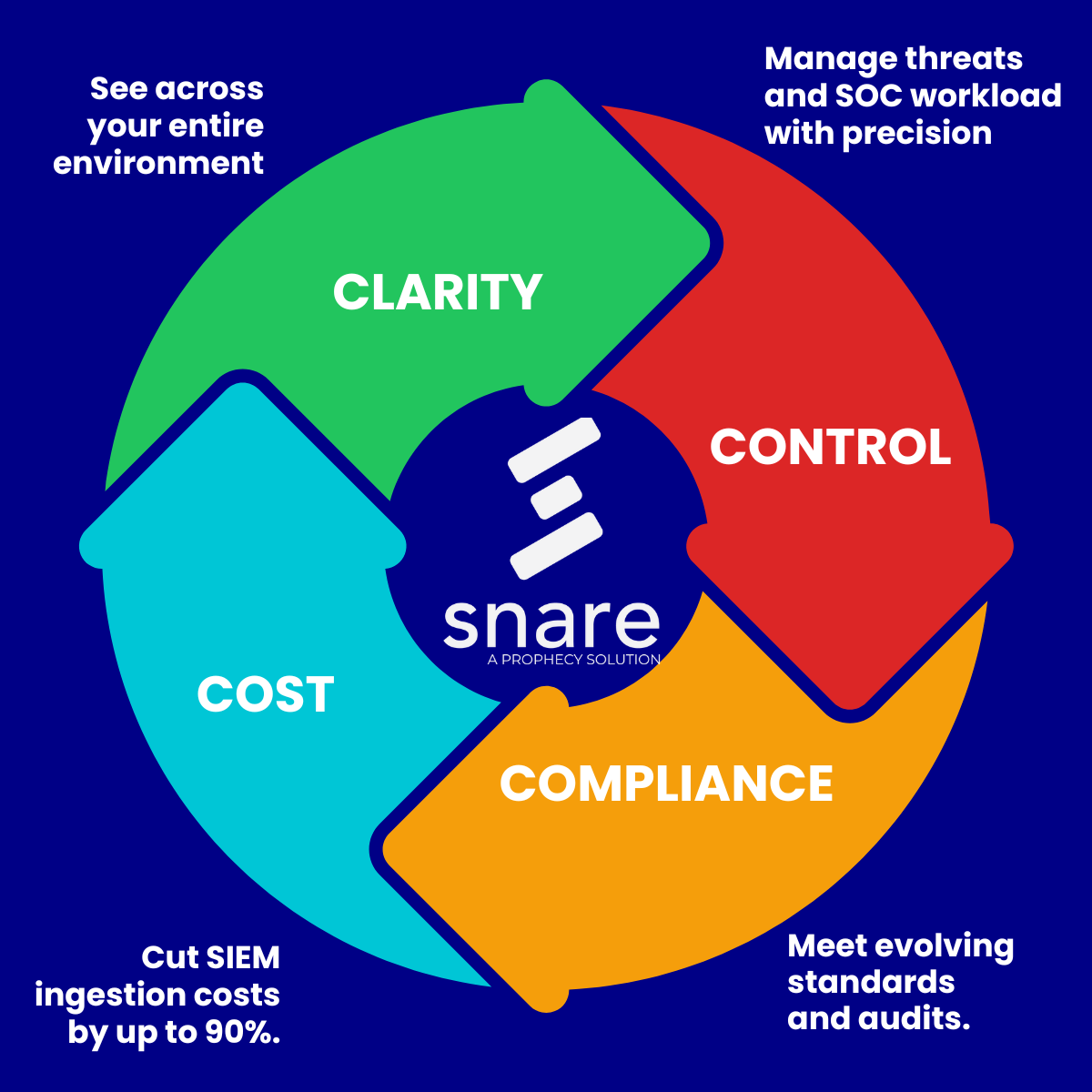
Filter, truncate, transform, and deduplicate log data at the source, before it reaches any platform that charges by volume.
As AI apps multiply the number of event-generating systems in your environment, the volume problem only grows. Reduce spend without reducing security.
Meet NIS2, DORA, CMMC, PCI-DSS, and HIPAA obligations with tamper-evident log archives and audit-ready reporting, without paying SIEM-tier storage rates.
Regulators are increasingly asking not just whether you were breached, but whether you could detect, investigate, and evidence the event. CISOs must ensure that AI implementations consider and support compliance requirements across GDPR, HIPAA, and PCI DSS, ensuring data collection and processing respect privacy mandates even in AI-driven analysis and response systems.
Break free from the cost-vs-coverage trade-off. Snare’s non-ingestion-based model means you can collect what security actually requires, not what the budget permits.
In environments where AI agents are generating new event types daily, coverage can no longer be a fixed scope determined at a point in time.
Route log data to any SIEM, analytics platform, or archive, simultaneously if needed. Change downstream vendors without re-engineering your collection layer.
As AI-native SIEM platforms emerge and the market continues to consolidate, the organisations best positioned are those that own their log data independently of any single platform.
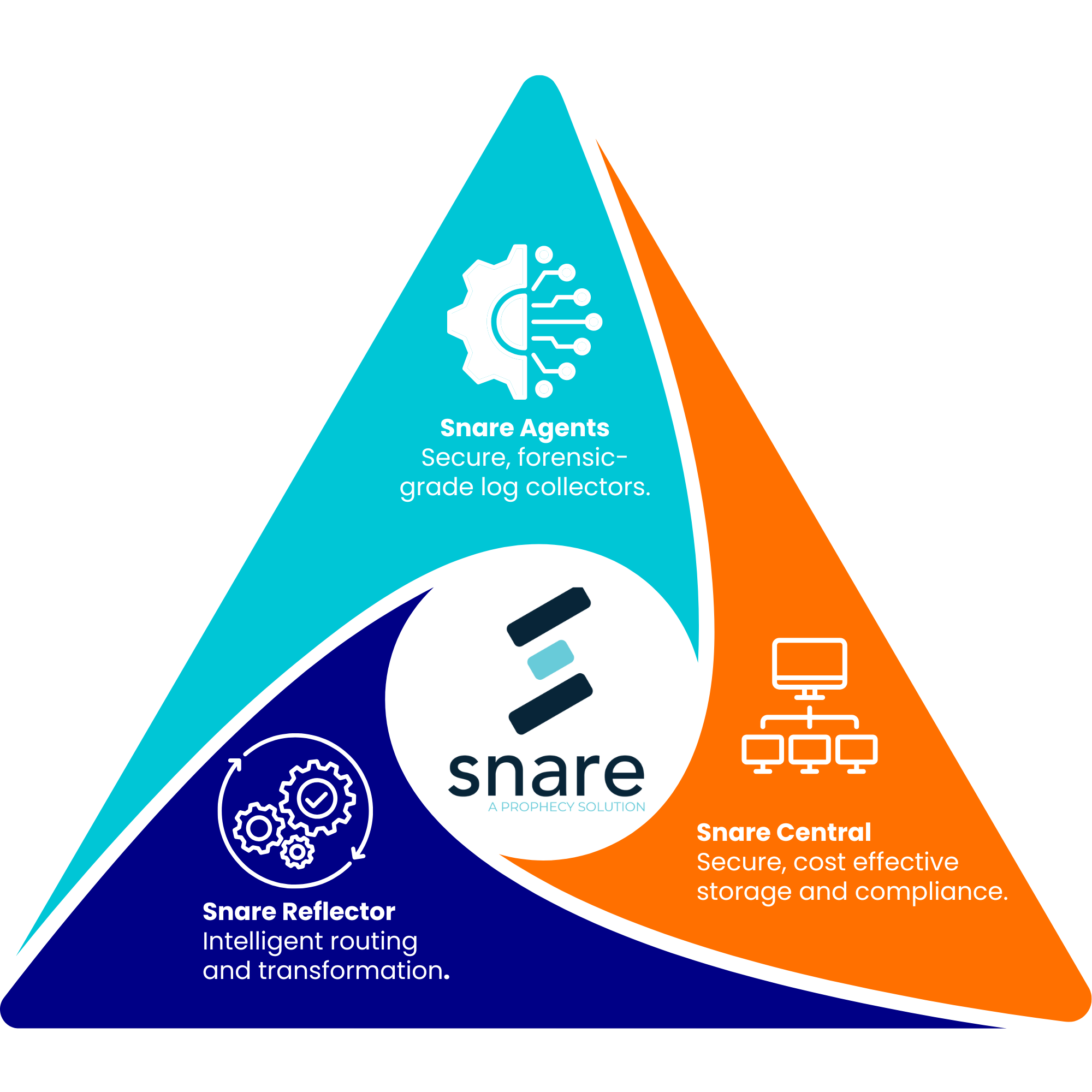
Snare’s product architecture reflects a clear philosophy: the collection and management layer should be independent from, and upstream of, expensive downstream platforms. Three components work together or standalone.
Snare Agent provides lightweight, forensic-grade log collection from hundreds of operating systems and device types. Trusted by governments, defence agencies, and Global Fortune 2000 enterprises, it is the most proven agent of its kind. Version 5.10 introduces standardised data collection across global security operations, ensuring consistency whether logs originate from a US datacentre, an APAC edge device, or a newly onboarded SaaS integration.
Snare Central centralises log management, applies compliance policies, enables cost-effective long-term retention, and powers precise forensic investigation. Its customisable dashboards give SOC teams real-time visibility into threats and compliance posture without requiring expensive specialist resources to maintain, a critical advantage in a market where there are only 35,000 CISOs worldwide serving an estimated 359 million businesses.
Snare Reflector routes, replays, and forwards log data to any destination, SIEM, XDR, analytics platform, or cold storage archive. It is the component that eliminates vendor lock-in, allowing organisations to evolve their security stack without being held hostage by any single platform’s pricing model.
Snare is particularly well-suited to managed security service providers and system integrators operating at scale.
For MSSPs, the AI question is not abstract, it is arriving in client conversations right now. Clients are deploying Copilot, deploying AI-assisted CRM tools, deploying productivity agents, and asking their MSSP whether they are covered. The honest answer, in most cases, is: only if the log layer underneath can see those systems.
For large enterprises managing heterogeneous environments — Windows, Linux, legacy Unix, databases, cloud workloads — Snare’s breadth of agent support removes a common gap in coverage strategies. And for organisations subject to multiple regulatory frameworks simultaneously, the ability to retain compliant log archives independently of any SIEM’s retention policies represents a meaningful risk reduction
AI-powered risk management platforms are helping MSSPs deliver faster onboarding, improved compliance management through continuous monitoring, and measurable ROI by reducing manual workloads, while enabling more profitable service delivery at scale. But the prerequisite for all of that is comprehensive, high-quality log data flowing from every corner of the client environment, including its AI-expanded edges.
Snare’s multi-tenancy architecture, flexible routing capabilities, and vendor-agnostic log layer make it a natural fit for MSSPs, not simply another tool in the stack. As AI apps multiply the number of event sources, the ability to collect consistently, filter intelligently, and route flexibly becomes a competitive differentiator, not just a technical capability.
With global cybersecurity spending projected at $308 billion in 2026 and security teams stretched thin against a 3.4 million-person talent shortage, the case for reducing operational complexity while strengthening forensic readiness has never been stronger.


If your organisation experienced a breach today, could your team reconstruct the full attack chain from available log data? If the answer involves any hesitation, if there are systems you know aren’t fully covered, retention gaps you’ve accepted to manage costs, compliance evidence that would need to be manually assembled, or AI apps you’re not entirely sure are being logged, then the log management layer deserves attention before the next incident, not after it.
The organisations that fare best in breach investigations, regulatory audits, and insurance claims are not necessarily those with the most sophisticated detection tools. They are the ones with comprehensive, high-fidelity, well-retained log data from a complete picture of their environment.
In 2026, that environment includes AI. Visibility starts at the source, and the source is evolving faster than ever.


 Prophecy International Launches AskSnare