Newsletter Article
THE SNARE PERSPECTIVE
Snare Insider Newsletter Series Article
Make sure you Subscribe


SIEM optimisation should not mean weakening security visibility. Snare provides a control layer between the systems generating security data and the platforms used to analyse it, trusted today by more than 4,000 organisations across five continents, with over 2.5 million enterprise agents deployed and typical storage savings of 90–98% at rest.
Snare Agent
Collects high-integrity security events directly from endpoints, servers and supported operating environments, with granular policies controlling what is captured and where it is sent.
Snare Central
Centralises log management, retention and analysis while supporting advanced aggregation, de-duplication, filtering, field remapping and event replay. This enables organisations to reduce avoidable volume while maintaining access to the underlying evidence.
Snare Reflector
Routes, transforms and forwards security data to one or multiple destinations according to policy. Different event categories can be delivered to the SIEM, archive, analytics service, customer environment or other downstream platform without duplicating the entire data stream unnecessarily.
AskSnare
Applies AI-driven intelligence across the Snare data layer, allowing teams to investigate activity using natural language, correlate events, detect deviations and receive explainable next-step recommendations.
Collect the evidence. Control the volume. Activate the intelligence.
COLLECT → CONTROL → RETAIN → ROUTE → REPLAY → INVESTIGATE → ACT
A sustainable logging strategy requires more than a SIEM configuration. It requires control across the entire data lifecycle.
Define logging requirements according to threat detection use cases, incident response requirements, regulatory and audit obligations, system criticality, data sensitivity, and required investigation depth. Collection policies should capture the evidence needed to reconstruct activity without relying entirely on broad, default configurations.
Apply filtering, parsing, field remapping, aggregation and de-duplication before unnecessary volume reaches high-cost analytics platforms. This can reduce repetitive or low-value data while maintaining the events and context required for detection.
Not every log needs to remain continuously available in the most expensive analytics tier. Retain high-integrity evidence within a cost-effective log management layer, with policies based on investigation, compliance and business requirements.
Send each category of data to the destination where it provides the greatest value: high-priority events to the SIEM, complete evidence to secure retention, relevant telemetry to analytics platforms, specific datasets to customer or tenant environments, and archived evidence to downstream systems when required.
An event that was not considered important when collected may become critical during a later investigation. Replay allows teams to retrieve and resend the relevant historical time window, source or event category without continuously paying to keep every record in a high-cost analytics tier.
AI can help analysts interrogate large datasets, correlate related events, identify anomalies and construct incident timelines. However, the quality of the result depends on the integrity and completeness of the underlying data.
The NIS2 obligations discussed in Section 3 raise the bar specifically for managed security service providers, you now need to demonstrate the resilience, integrity and availability of the logging service itself, independently of the customer environments it observes, and to do it across every tenant. That’s a different problem to solve at 5 clients than at 500.
Snare Reflector’s per-policy routing means a single collection layer can serve multiple tenants and multiple downstream SIEMs without duplicating the entire data stream for each one, relevant events to each customer’s own SIEM or analytics platform, complete evidence retained centrally for audit and cross-tenant threat intelligence, and replay available per-tenant when a historical window needs to be reconstructed for one customer without touching another’s environment. For MSSPs already absorbing ingestion costs across a growing client base, that separation of collection from ingestion is often where the margin actually lives.
☐ Centrally collect authentication, SSO and MFA events across all identity providers
☐ Log SaaS/CRM administrative and bulk-export activity, not only infrastructure logs
☐ Monitor service accounts and API tokens for anomalous first-use or geographic patterns
☐ Correlate privileged account activity with new account, service or permission creation
☐ Extend logging obligations into vendor and third-party access, not only internal systems
☐ Retain identity evidence long enough to reconstruct a slow-building compromise
The Snare perspective
Identity-based compromise is a correlation problem, not a collection problem for most organisations, the logs often exist, scattered across identity providers, SaaS platforms and endpoints, but nobody is asking the right cross-source question in time. This is precisely the gap AskSnare is built to close.
Traditional log investigation is often reactive. An alert is generated. An analyst identifies relevant systems. Queries are written. Multiple datasets are searched. Timelines are manually assembled. Additional context is requested. Potential response options are evaluated. The process can take hours while risk continues to develop.
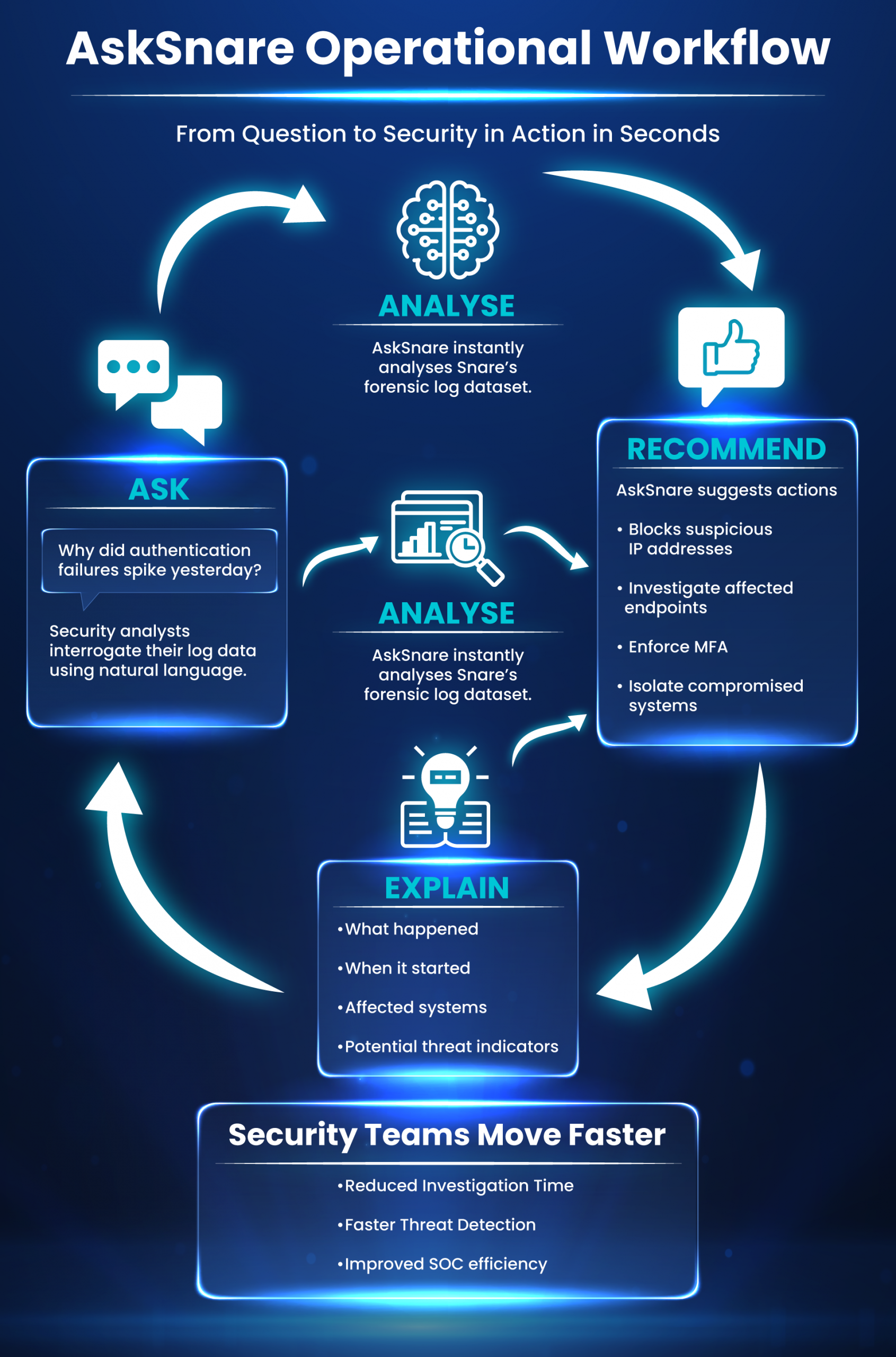
AskSnare changes how analysts interact with the evidence. Security teams can ask questions such as:
AskSnare can correlate across relevant datasets, trace related activity and explain the reasoning behind its findings, exactly the kind of cross-source correlation needed to catch the identity-based compromise patterns described in Issue 12 of the Snare Insider Threat Spotlight.
This matters beyond convenience. The same SANS 2025 survey referenced in Section 5 found that 70% of analysts with five years or less of experience leave their roles within three years, with false positives and alert fatigue cited as leading contributors. Correlation and explanation that would otherwise consume an analyst’s afternoon, done in seconds, with the reasoning shown, is not just a productivity gain; it is one of the few practical levers available against a structural SOC retention problem.
AskSnare continuously monitors for deviations from expected patterns, helping teams identify unusual activity before it becomes a larger incident. It can support earlier identification of suspicious behaviour, faster investigation of related events, detection of unexpected changes in logging activity, timeline construction across systems, identification of potentially compromised accounts, recommended escalation or containment actions, and explainable and auditable investigation outputs.
AskSnare operates as a human-in-the-loop capability. It recommends and explains. The security team decides and acts. This gives analysts the speed of AI-assisted investigation while keeping operational control and accountability with the organisation.


 AUSTRALIA’S RANSOMWARE REPORTING REGIME: NOW IN ACTIVE COMPLIANCE